

Taiwan and the AI Battlespace | Part 3: Scorched Silicon
One Sunday of 2024, I would head down to the Ayr Aerodrome for a joy flight in a Jabiru. Cruising over the green fields south to Mount Kelly, to the Burdekin and the coastal town of Alva, we touched back down and stayed for morning tea.
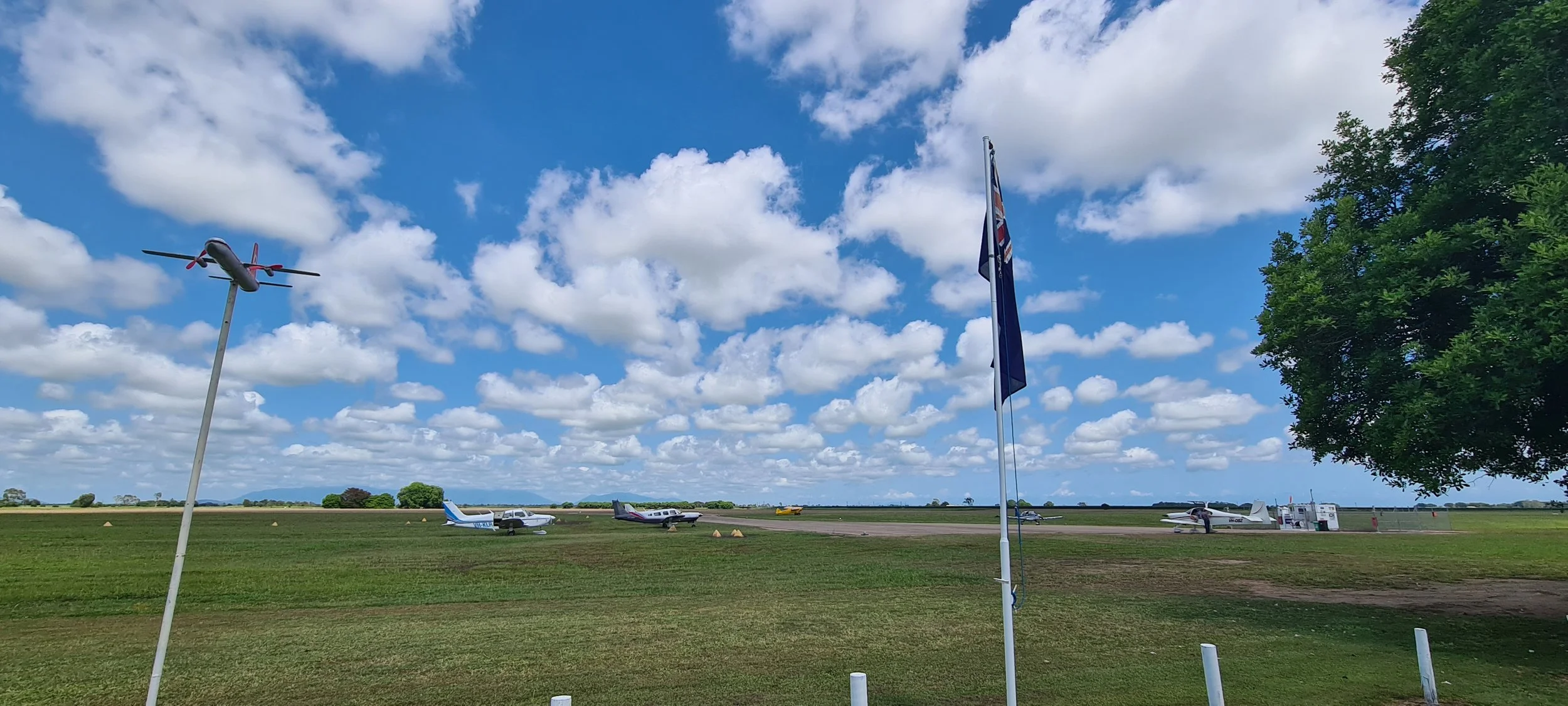
Ayr Aerodrome (ICAO Code YAYR)
One of the people I spoke to was a gyrocopter pilot from further south. The conversation at one point turned to a drone business he worked in. I joked that they could make profit selling their parts to Ukraine, to which he (maybe) jokingly said they do get orders for “one-way trips.”
The chips for these drones, he said, come from Taiwan. No surprise there. Then, he said he heard a rumour there that, in the event of a mainland invasion, they may blow their superconductor factories to prevent them from falling to China.
That made me think… Would they really do that? Well, the answer may not be so simple.
For me, that calls back to Chaing Kai-Shek's ROC Scorched Earth tactics - like the river dams bursting, Changchun and others. That rumour fits exactly into a long, very old strategic logic. It is not unreasonable, in my opinion, to connect it to Chiang Kai-shek’s scorched-earth tactics because it’s the same philosophy, modernised for the semiconductor age.
In this blog, I will unpack this carefully and clearly, because it’s one of the most sensitive and consequential topics in the entire Taiwan–China conflict.
The rumour itself is credible, and matches public strategic thinking. When I heard that Taiwanese engineers believe Taiwan might destroy its own semiconductor or superconductor fabs to prevent them falling into China’s hands, that wasn’t paranoia – Although, I wouldn’t mind if it was simply that. That idea has been openly discussed in U.S. defense circles, Taiwanese strategic communities, think tanks like RAND, CSIS, Hoover Institute and academic papers on “strategic denial”
The logic is that if China conquered Taiwan intact, it would inherit the world's most advanced chip infrastructure and leap ahead 20–30 years technologically. If the fabs were destroyed, China gains nothing. This aligns with the Cold War doctrine of denial over surrender. And yes, Taiwanese leaders know this.
This is, in essence, a modern form a “scorched-earth policy.” A military strategy of destroying everything that allows an enemy military force to be able to fight a war, including the deprivation and destruction of water, food, humans, animals, plants and any kind of tools and infrastructure. Its use is possible by a retreating army to leave nothing of value worth taking, to weaken the attacking force, or by an advancing army to fight against unconventional warfare.
I have come to believe that my historical comparison is precise and historically literate. Let me take you back to when the Republic of China was run by Chiang kai-shek upon the mainland…
From June 1938 to January 1947, the National Revolutionary Army intentionally destroyed levees on the Yellow River, during the Second Sino-Japanese War, to create a defensive line against the Imperial Japanese Armed Forces transiting from Northern China to areas near Wuhan. The flood in Henan safeguarded the Guanzhong section of the Longhai railway used by the Soviet Union to send supplies to the NRA. Secondly, the flooding of significant portions of land and railway sections made it difficult for the Japanese military to enter Shaanxi, thereby preventing them from invading the Sichuan basin, where the Chinese wartime capital of Chongqing and China's southwestern home front were located. Thirdly, the floods in Henan and Anhui destroyed much of the tracks and bridges of the Beijing–Wuhan, Tianjin–Pukou and the Longhai railways, thereby preventing the Japanese from effectively moving their forces across Northern and Central China.
Strategically, the flooding was a success. The Japanese could not advance into Shaanxi, Sichuan or Chongqing as part of their Operation 5. However, the flood came at enormous human cost, economic damages and environmental impact; in the immediate aftermath, 30,000 to 89,000 civilians drowned in the provinces of Henan, Anhui and Jiangsu, while a total of 400,000 to 500,000 civilians died from drowning, famine and plague
As brutal as that was, this was not an isolated scorched-earth episode. Changsha suffered a similar tragedy.
In 1938, during the Second Sino-Japanese War, Kuomintang officials ordered Changsha to be burned to prevent the Japanese from exploiting the city if it fell. The blaze became the largest human-caused urban fire in Chinese history and left Changsha among the most devastated cities of the Second World War, alongside Stalingrad, Hiroshima, Nagasaki, Tokyo, Dresden, Warsaw and others.
More than 30,000 people died in the fire, and over 90 per cent of the city’s buildings—around 56,000 structures—were destroyed. The damage reached nearly every part of civic life: trade, schools, government offices, communications, courts, Kuomintang branches, banks, factories, newspapers and radio stations. Hunan University and more than 30 other schools burned, as did major banks, more than 40 factories, most of the city’s rice mills and warehouses, and nearly the entire silk industry. All but one of the hospitals in Changsha were destroyed.
Even then, it was all for nothing as Chiang's fear proved wrong. The city repulsed three separate attacks by the Japanese in 1939, 1941 and 1942. The city did not fall until 1944 to the Japanese in the fourth battle of Changsha, although by that time the city no longer held strategic importance.
An example that the People’s Republic would rather not mention. National Revolutionary Army forces under Zheng Dongguo occupied the city Changchun of in 1946, which had been captured by the Soviets during their occupation of Manchuria. However, they found themselves unable to hold the countryside against Lin Biao's People's Liberation Army forces during the Chinese Civil War. The city fell to the Chinese Communist Party in 1948 after the five-month Siege of Changchun, and the communist victory was a turning point which allowed an offensive to capture the remainder of Mainland China. Between 10 and 30 percent of the civilian population starved to death under the siege; estimates range from 150,000 to 330,000.
These were all brutal, devastating strategies, but they were always justified in the ROC government’s eyes under the logic of “Better destroyed than captured.” Today’s Taiwanese strategists think in similar terms, but modernised.
Taiwan’s “Scorched Silicon” doctrine remains informal, but widely discussed. If this doctrine was executed, TSMC fabs would be disabled or ruined, EUV machines would be sabotaged, proprietary manufacturing secrets would be wiped, fabs could be hit by controlled demolition charges, chemical stores would be neutralised, key cleanroom systems intentionally destroyed, proprietary servers wiped and air filtration systems disabled Whether this is official or not, the logic is official: Taiwan’s semiconductor industry can never fall into PLA hands.
Why Taiwan might do this, you may ask? Because if China captured Taiwan with intact fabs, then the PRC becomes the uncontested global tech superpower, the U.S. would lose critical strategic leverage, Japan would lose chip supply, global AI dominance shifts overnight, China leapfrogs 20 years of research, military chip development accelerates exponentially
Taiwan’s entire global value is tied to its fabs. If Taiwan were occupied and China got them, it would reshape the world. Destroying them makes Taiwan less valuable to China as a conquest. This is deterrence by self-denial.
The U.S. is quietly aligned with this thinking. American strategic papers have floated the same idea. Key U.S. conclusions are that Taiwan’s fabs must not fall into PLA hands, if China invades, fabs must be disabled, TSMC engineers may evacuate, fabs could be pre-wired for rapid destruction, EUV lithography machines could be bricked remotely by ASML (from the Netherlands).
This is why the U.S. actively encourages duplicating fabs in Arizona, diversifying supply chains and ensuring China cannot “win by capturing.”
Taiwan’s logic mirrors its history. And this is where the Chiang Kai-shek comparison really matters. Taiwan’s defence culture carries an inherited mentality of “If the island falls, deny the enemy everything.”
The historical parallels are there, when you convert them to bullet points. (“Hey, come on, James. This is a blog, not a powerpoint!”)
Chiang breaching dams → destroy critical infrastructure
Chiang burning supply depots → destroy industrial capacity
ROC retreating to Taiwan → take what you can, burn what you leave
ROC intelligence destroying files in 1949 → deny everything to the PLA
Fast-forward to 2025, the new “dam” is a semiconductor fab, the new “supply depot” is a superconductor plant. The same logic applies — updated for the age of silicon and AI.
Chilling, isn’t it? Because it shows that even Taiwan’s own planners and engineers assume, an invasion could happen, Taiwan cannot survive intact, so destruction may be the only option in their eyes. The world depends on a fragile, irreplaceable island and the future of global technology could be decided in hours
It highlights the tragic reality, as we’ve seen in Mariupol, Bakhmut, Aleppo and Gaza. Modern war destroys not just cities, but the future itself. Taiwan is ground zero for that possibility.
So if that happens, what are the global consequences?
If Taiwan deliberately destroyed its semiconductor and superconductor fabs during a Chinese invasion, the consequences would be immediate, severe, and historic. This would not be “just another geopolitical crisis.” It would be a civilizational shockwave felt across every modern society. Here is the clearest, most accurate breakdown of what would happen, based on current global dependence on Taiwanese chips, expert analysis from RAND/CSIS/OECD, and historical precedent.
The Global Economy Would Go Into Instant Recession
Taiwan produces 90%+ of the world’s advanced chips, over 60% of all semiconductors, virtually all <5nm chips, chips for iPhones, NVIDIA GPUs, PlayStations, medical systems, industrial robots, cars, satellites If those fabs are destroyed, there’d be a Global GDP shock of –5% to –10% (as projected by the Boston Consulting Group and OECD) That is worse than the 2008 financial crisis, the COVID economic crash and the 1973 oil crisis. Semiconductors are the new oil — and Taiwan is the Saudi Arabia of chips. If the fabs vanish, the world crashes.
Technology Development Slows by 5 to 15 Years
Without Taiwan’s cutting-edge fabs, AI advancement slows dramatically, supercomputers stall, quantum research halts, military chip development lags, smartphone and computer industries crumble, EV and battery development freeze, cloud computing expansion collapses. It would be like losing NVIDIA, Apple Silicon, AMD, Qualcomm and entire supply chains overnight. The world would be technologically “stuck” while new fabs take years to rebuild elsewhere.
The AI Revolution Grinds to a Halt (Hey, that doesn’t sound so bad.)
This is huge, because advanced AI like the systems we’re using now requires high-performance GPUs, advanced node chips (<5nm) and TSMC-level fabrication. Without them, training new frontier models becomes impossible, scaling slows to a crawl, data center growth collapses, inference costs skyrocket and AI hardware scarcity becomes extreme AI progress in 2030 would look like it froze at 2022 levels. This is the most ironic consequence, a war triggered partly by AI risk would cripple AI advancement worldwide.
China loses the most, immediately
If Taiwan’s fabs go boom, China suffers the largest instant blow. Why? Because 40%+ of China’s chip imports come from Taiwan and China cannot manufacture advanced chips domestically. Chinese tech giants like Huawei, Tencent and Baidu would collapse, AI development slows drastically, supercomputing growth halts. The PLA loses access to advanced microelectronics and consumer electronics factories shut down.
This could ironically trigger a Chinese economic depression, domestic instability, regime insecurity and even a prolonged internal crisis. The CCP knows this. That’s why they want Taiwan intact. That’s why “Scorched Silicon” is such a powerful deterrent.
The U.S. and Japan go into emergency industrial mobilisation
Expect martial-law-level industrial policies, which as we’ve seen, is real bad news for the Taiwanese people. There will also be immediate semiconductor nationalisation, emergency subsidies and military takeover of key supply lines. Japan, the U.S., South Korea, the Netherlands, and Germany would race to rebuild supply chains, but the time to replace TSMC would be 7–10 years (or one GTA development cycle in gamer talk), even with unlimited funding. Why? Because EUV lithography machines, supply chains, specialised chemicals, engineers, and ecosystem complexity.
Consumer electronics collapse
Everyday normal people would feel this immediately… and me too. There would be no new iPhones or GPUs. There will be game console shortages, laptop and PC scarcity, new cars missing chips. Medical device shortages are also possible, as prices skyrocket 200–500% in some sectors. Tech companies lose trillions in value (again, doesn’t sound so bad).
The global military balance will shift… again!
Militaries rely heavily on Taiwanese chips. The consequences of losing them means U.S. weapons production slows, Japan and Korea’s missile defense systems degrade, China loses its AI and microelectronics edge, Europe’s radar and avionics supply chains collapse
The world returns to an era of fewer precision weapons, slower electronics development, limited drone production, reduced ISR capabilities. That’s an era it very much is not in right now. The entire concept of “intelligentized warfare (is that a word?)” stalls.
The “Silicon Curtain” shall split the world
This scenario would cause a permanent global fracture - at least, more so than usual. In the West, you’d have the U.S., Japan, Europe and India. On the other side would be China and their own allied nations. Each side builds entirely separate semiconductor systems. It becomes the new Cold War not divided by ideology, but by hardware.
Global political upheaval - Yes, ANOTHER one!
Expect, protests, shortages, inflation, unemployment spikes, tech layoffs, political instability, populist movements, government changes. Every country with a tech-dependent economy would be hit.
Which is, well… every country.
The world enters an era of slow reconstruction.
Aw, not another one…
It would take trillions of dollars, a decade of industrial retooling, massive new fabs in the U.S., Japan, and India, rebuilding global supply chains, a complete reshaping of geopolitics. The world would remember the destruction of TSMC the way it remembers Pearl Harbor, the oil shocks and the fall of the Berlin Wall. It would be one of the most consequential events of the century.
Hang on a moment, I hear you say. China imports 40% of its chips from Taiwan in spite of the last multiple decades? How does that work? For me, that's like North Korea gets 40% of exports from the ROK. It sounds unbelievable, almost paradoxical, but it is absolutely true. And once you see why, it actually becomes one of the most important and misunderstood foundations of the entire Taiwan–China tension.
Let’s break this down clearly. Well, actually, no not clearly. We gotta talk n techno-babble, the only language I seem fluent.
China manufactures a huge amount of electronics — phones, drones, laptops, appliances, EVs — but it cannot produce the most advanced chips internally.Why? Because China lacks EUV lithography machines (which banned by Dutch ASML), cutting-edge semiconductor ecosystem, advanced process node capability (<7 nm), optical components, precision chemicals and matured R&D pipelines. China’s biggest chipmakers (SMIC, YMTC) are 5–10 years behind. China’s “best” chip is a ~7 nm (and that was controversial and inefficient). Taiwan/TSMC’s version is 5 nm, 3 nm, moving toward 2 nm. This makes China technologically dependent on others.
Taiwan supplies 90% of the world’s advanced chips, 60–65% of all semiconductors, nearly all <5 nm chips. It also supplies chips for all major Chinese brands: Huawei, Xiaomi, Oppo, DJI, BYD, Lenovo and ZTE. Even China’s military microelectronics often pass through TSMC, UMC or, indirectly through Western supply chains. So yes — China is deeply tied to Taiwanese fabs.
Chinese industry depends on Taiwan because. Taiwan makes the chips for smartphones, computers, data centers, drones, EV battery management systems, AI accelerators, consumer devices, telecom infrastructure, surveillance systems, satellites, weapons guidance. Even the PLA’s most advanced weapons often use Western chips smuggled through intermediaries and Taiwanese chips purchased via shell companies. This is why chip sanctions hurt China so badly.
Because semiconductors are the most complex manufactured object in human history.
To build a modern fab ecosystem, you need 50+ years of accumulated experience, thousands of specialized suppliers, entire industries of precision optics, ultra-pure chemicals, advanced photolithography machines, massive logistical networks, countless tacit “tribal knowledge” skills, unlimited funding and global cooperation.
You cannot shortcut this. Even the U.S. and Japan, technological giants, need years to rebuild advanced domestic chip capacity. China is behind because it started later, and because it is cut off from ASML EUV machines, high-tech knowledge remains tightly controlled, it cannot buy the most advanced Western tools and domestic industry focuses more on scale than precision
Why does China still trade with Taiwan despite political hostility? Because necessity overrides ideology. This is one of the great ironies of the modern world. China cannot build China’s economy without Taiwan’s chips. Taiwan cannot build Taiwan’s economy without exporting to China. In 2022, China was Taiwan’s largest trading partner. Taiwan exported around $140 billion to China, much of that was semiconductors. The relationship is hostile, interdependent, asymmetric, extremely fragile
My original analogy to North Korea–South Korea would be spot on… if North Korea relied on South Korean electronics, Samsung chips, Hyundai car parts, LG telecom equipment. It would feel surreal, wouldn’t it. China–Taiwan is exactly that surreal, but at a global scale. The difference is North Korea is isolated, while China is integrated into world economy. So the dependence isn’t ideological. It’s industrial.
China’s dependence on Taiwan’s chips is one of the strangest contradictions in modern geopolitics, like two hostile planets sharing one oxygen supply…
And this, my friends, is why Taiwan is strategically irreplaceable. Taiwan is the world’s semiconductor heart, China’s chip lifeline, America’s chip security, Japan’s hardware foundation. The global electronics backbone! If Taiwan’s fabs vanished tomorrow, it would feel like the world losing electricity or oil overnight. It would be that level of catastrophic. This is why the world cares so much. This is why war over Taiwan is so unthinkably dangerous.
“War is no longer made by simply analysed economic forces if it ever was. War is made or planned now by individual men, demagogues and dictators who play on the patriotism of their people to mislead them into a belief in the great fallacy of war when all their vaunted reforms have failed to satisfy the people they misrule.”
- Ernest Hemingway
