

Taiwan and the AI Battlespace | Part 2: War
Previously…
The year was 2023, and I was travelling through Taiwan with my good friends and fellow authors, James Rosone and Miranda Watson. We were only a few days into what would become an unforgettable military research tour of the island. Our first accommodation was the Caesar Park Hotel in Banqiao District, New Taipei City, a modern cityscape of towering buildings, shopping centres, and transport hubs that would serve as our base while we explored northern Taiwan.
Whenever our schedule allowed, I enjoyed wandering the surrounding streets on foot. My walks often took me along Section 2 of Xianmin Boulevard, from the tranquil paths and lakes of Xinban Metropolitan Park to the bustling restaurants, cafés and department stores nearby. It was a fascinating contrast. One moment I was surrounded by quiet greenery, turtles basking in the water beneath monsoonal skies; the next I was immersed in the energy of one of Taiwan's busiest commercial districts.
One afternoon, I rode the escalators through the No. 3 building of the shopping complex, home to Showtimes Cinemas. Families wandered between cafés, children posed for photographs beside colourful dinosaur statues, and shoppers browsed the many stores that filled the complex. Among them was a bookstore that I found myself returning to more than once.
Each time I walked past, one particular book caught my attention. It was a Taiwanese book about artificial intelligence, a subject that seemed impossible to ignore during my time on the island. Taiwan's news, universities and technology sector all reflected a society investing heavily in AI and advanced computing. Eventually, curiosity got the better of me. I bought the book, despite knowing my Mandarin was nowhere near advanced enough to read it.
Fortunately, modern technology provided an answer to the language barrier. Using the camera function in Google Translate, I was able to translate each page almost instantly. It was a slow process, but it opened a window into how Taiwanese writers and technology professionals viewed AI in 2023. A snapshot of optimism and ambition at a moment when the world was only beginning to grasp just how rapidly artificial intelligence would reshape society.

“Artificial Intelligence: The drive to change the future.”
“Don't be afraid of robots taking your jobs, a Complete Guide to Self-Empowerment… What you should know about AI efficiency tools and applications. Cultivate Human-Machine Collaboration! Let AI become your amazing teammate… Innovative applications, intelligent transformation and advanced deployment of business opportunities | Create the necessary leap forward to win in the future…”
“Written by Wu Youzhong, blockchain application empowerment professional consultant.”
“Stand on the shoulders of AI giants, control AI, and use AI intelligently! Create infinite possibilities!””
So why am I telling you this?
AI will play a massive, decisive role in any war between China and Taiwan, far more than in any conflict we’ve seen so far. My friend James Rosone made it a central theme in The Monroe Doctrine, and then again in his current World on Fire series because militaries across the world already know this is where warfare is heading.
Here’s my clearest breakdown of the roles AI will likely play, based on what I’ve seen across real-world PLA doctrine, ROC modernization plans, U.S. Indo-Pacific strategy, and the latest global military trends.
AI-driven Intelligence, Surveillance and Reconnaissance (ISR) will be the most critical function on the battlefield. For China, the People’s Liberation Army (PLA) is expected to leverage AI to process satellite imagery in real time, track the movements of the Republic of China (ROC) Air Force, identify vulnerabilities in Taiwanese defences, locate mobile missile launchers, coordinate drone swarms, and detect stealth ships or aircraft. China’s advantage in this area comes from its substantial AI processing capacity, which is powered by massive supercomputers, vast datasets, and the world’s largest camera and surveillance network, all contributing to superior battlefield awareness.
On the other hand, Taiwan will also employ AI to detect invasion formations, coordinate air raid alerts more rapidly, identify and counteract disinformation campaigns, automate missile targeting, monitor PLA naval manoeuvres, and predict patterns of cyberattacks. Although Taiwan is limited by its raw computing power, support from the United States means that AI-enhanced ISR will significantly strengthen its early warning capabilities.
AI will play a decisive role in cyber warfare, marking the initial stage of any conflict between China and Taiwan—long before the first missile is launched. China is expected to employ AI to attack Taiwan’s power grid, paralyse government networks, jam communications, fabricate deepfake broadcasts announcing “Taiwan surrendering,” overwhelm telecom networks, cripple banks, launch automated phishing and malware attacks, and create fake military orders to confuse defenders. Instead of relying solely on physical bombardment, China aims to digitally suffocate Taiwan. In response, Taiwan will leverage AI to filter out disinformation, restore compromised systems, detect cyber intrusions, harden critical infrastructure, counter deepfake propaganda, track botnets, and support its cyber defenders. Despite these measures, cyber remains an area where Taiwan faces significant vulnerabilities… and China is well aware of this weakness.
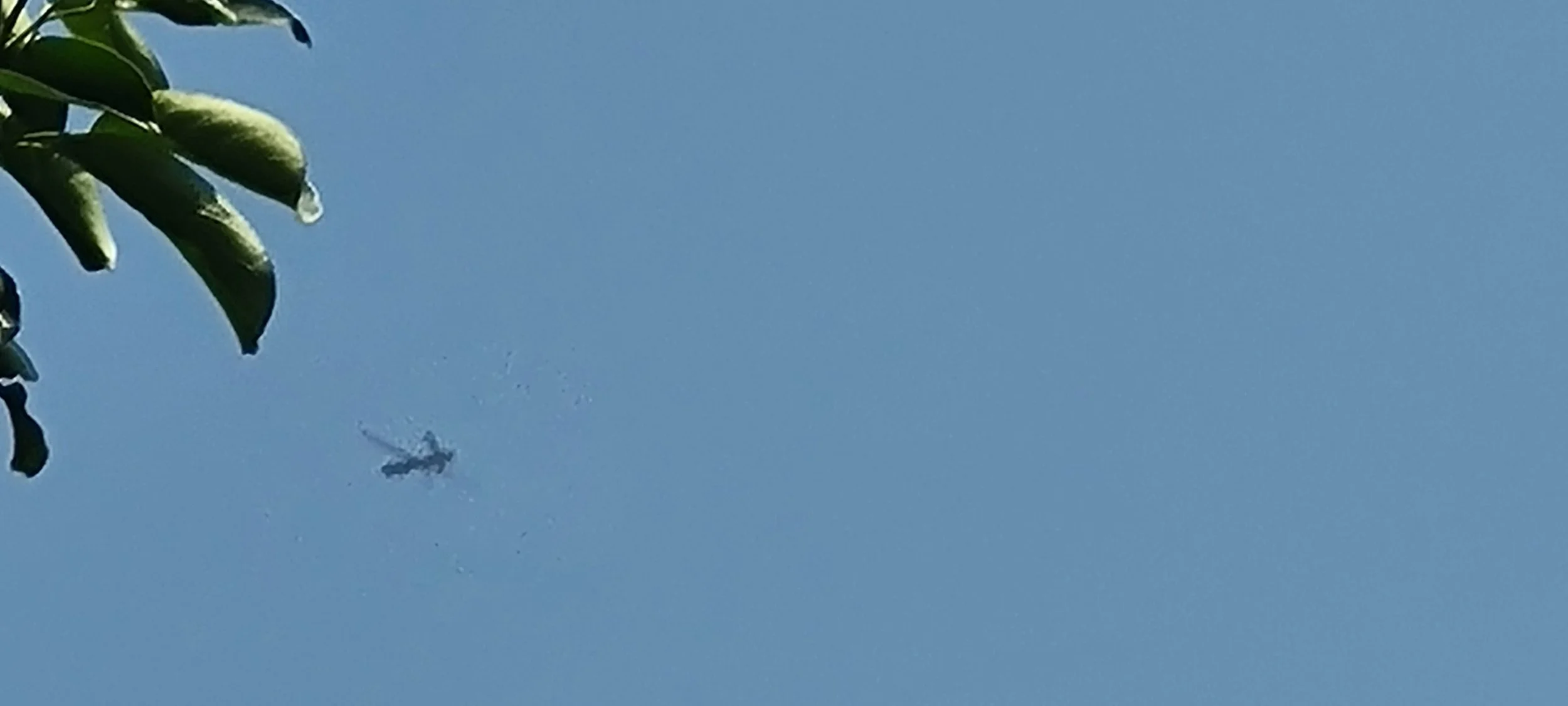
The Teng Yun (“Cloud Rider”) UAV under development by the National Chung-Shan Institute of Science and Technology (NCSIST). Photographed by me in Hualien during a flight at the nearby ROC Air Force Base
AI-controlled drone swarms are poised to become one of the most dramatic innovations in modern warfare. China’s People’s Liberation Army (PLA) has channelled significant resources into developing autonomous kamikaze drones, advanced swarm coordination, AI-guided quadcopters, long-range drone carriers, and underwater drones for anti-submarine warfare. With these capabilities, China could potentially deploy tens of thousands of inexpensive kamikaze drones in an attempt to overwhelm Taiwanese air defence systems, radar installations, surface-to-air missile (SAM) launchers, naval assets, mobile convoys, and critical infrastructure such as power stations. The scale of such operations is beyond the management capacity of human operators—a 3,000-drone swarm, for example, can only be coordinated effectively with artificial intelligence at the helm.
In contrast, Taiwan’s strategy is geared towards defence, focusing on smaller yet highly intelligent systems. Their approach includes the use of AI-guided portable drones, anti-swarm defence mechanisms, AI-driven targeting for Stinger and Mistral missile teams, domestically produced first-person view (FPV) kamikaze drones, and airbase defence drone interceptors. These systems are designed to provide agile and targeted responses to incoming threats, maximising effectiveness despite more limited resources compared to China’s vast drone arsenal.
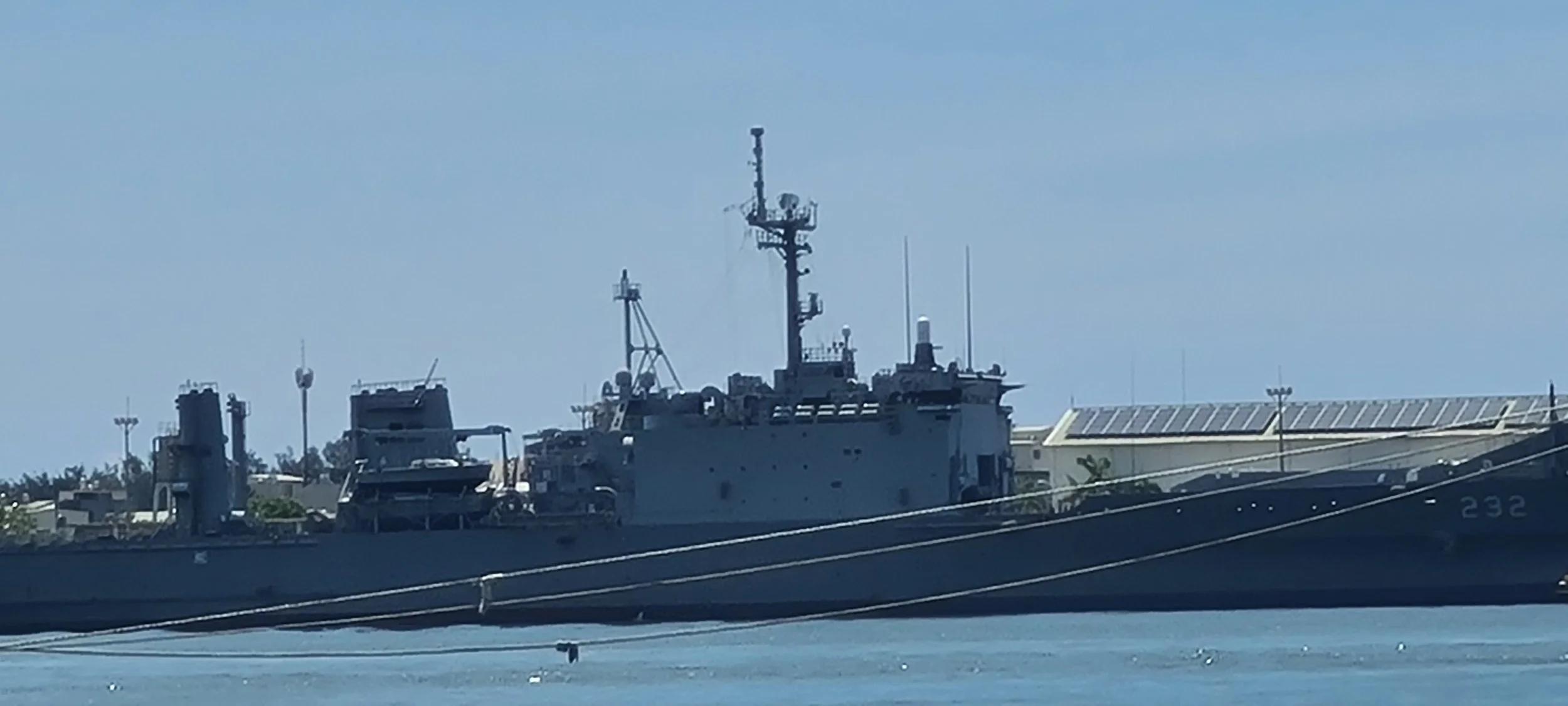
The Taiwanese Navy ship ROCS Chung Ho (formerly USS Manitowoc), a Newport-class tank landing ship recommissioned in 1997 and acquired in 2000 as part of the Security Assistance Program. Photographed by me in Kaohsiung in 2023.
In the realm of autonomous naval warfare, artificial intelligence is set to transform battles at sea into contests between algorithms as much as between ships themselves. The People’s Liberation Army (PLA) Navy is expected to employ AI to coordinate a range of unmanned systems, including unmanned surface vessels (USVs), underwater drones, and mine-laying autonomous craft, as well as providing AI-driven navigation for amphibious fleets. These advancements will make China’s invasion forces significantly harder to detect and counter. Meanwhile, Taiwan will harness AI-powered systems to predict landing trajectories, identify decoy vessels, direct anti-ship missile batteries, deploy unmanned sea mines, and monitor amphibious staging zones. As a result, any future sea battle in this context will be shaped by the effectiveness of competing algorithms, with each side seeking to outmanoeuvre the other through superior technological integration and rapid decision-making.
AI-assisted missile targeting is set to dramatically enhance both sides’ capabilities in any conflict scenario. The integration of artificial intelligence greatly improves precision, reaction time, adaptive targeting, and the effectiveness of countermeasures.
For China, AI will guide large swarms of missiles by tracking mobile surface-to-air missile (SAM) systems, identifying when enemy radars are switched off, and exploiting any gaps in air defences. These systems can dynamically adjust flight paths and coordinate multi-directional strikes, allowing, for example, up to 500 cruise missiles to continuously adapt to the Republic of China’s (ROC) defence responses in real time.
On the Taiwanese side, AI will be crucial for tracking incoming missiles, resolving radar clutter, allocating interceptor missiles efficiently, and positioning mobile launchers. AI will also help coordinate “shoot-and-scoot” tactics, enabling rapid repositioning to avoid counterstrikes. The overall porcupine strategy, which is designed to maximise survivability and resilience, will increasingly rely on AI-driven enhancements to outlast and blunt any missile assault.
Disinformation warfare and deepfake psychological operations are expected to play a massive role in any future conflict. China is likely to inundate Taiwan with fake videos showing Taiwanese leaders surrendering, AI-generated news anchors, fabricated battlefield footage, deepfaked generals issuing false orders, fake evacuation instructions, demoralising voice-cloned phone calls, and AI-generated social media panic. Given Taiwan’s highly digital connectivity, these psychological operations could be severely damaging if not countered rapidly. In response, Taiwan will employ AI filtering to identify fake content, use verification tools, automatically debunk deepfakes, and rely on U.S.-supported information integrity teams. In this environment, the information domain will become a critical frontline battlefield.
AI-enhanced logistics will be a decisive factor in determining the sustainability of military operations, with armies ultimately rising or falling based on the effectiveness of their logistical support rather than direct combat. China is expected to leverage artificial intelligence to schedule troop deployments, coordinate naval convoys, track fuel and ammunition usage, and optimise beach landings. On the other hand, Taiwan will employ AI to monitor hospital supply chains, reroute vehicles when roads are bombed, manage blackouts, prioritise humanitarian support, and allocate scarce military resources. These advanced applications of AI will play a significant role in shaping how long Taiwan can withstand sustained military pressure and maintain its operational resilience.
AI-driven command and control represents the closest approach to a true “Rosone-style” battlefield AI. On the Chinese side, the People’s Liberation Army (PLA) is already engaging with the concept of “intelligentised warfare” (智能化戰爭), where artificial intelligence is tasked with making battlefield decisions at speeds that outpace human reaction. The PLA’s objectives include AI-supported decision-making for generals, the use of AI for battlefield prediction, and automated threat prioritisation. Their focus is not on building a Skynet-like system, but rather on achieving cognitive speed supremacy to gain an edge in conflict scenarios.
In contrast, Taiwan, operating with more limited resources, will rely heavily on U.S.-supported battlefield AI to bolster its capabilities. This strategy features mobile tactical AI for squads and decision-support tools for officers, providing enhanced situational awareness and faster response times. The behind-the-scenes presence and support of the United States will be critical in enabling Taiwan to compete in the increasingly AI-driven theatre of modern warfare.
Autonomous air combat is increasingly defined by the integration of partially pilotless aircraft. China’s “Loyal Wingman” drones, which bear resemblance to Australia’s Ghost Bat program, are designed to accompany fighter jets, extend radar coverage, conduct kamikaze attacks, safeguard manned aircraft, and potentially overwhelm Republic of China Air Force (ROCAF) jets by sheer numbers. In contrast, Taiwan is exploring the use of smaller versions of these systems, focusing on their utility for decoy operations, reconnaissance, and improvised air-to-air defence. However, China currently maintains a significant advantage in terms of drone volume, giving it a considerable edge in this domain.
Artificial intelligence will serve as the brain, eyes, ears, nervous system, communications hub, disinformation engine, cyber shield, and cyber sword of future warfare. In essence, AI will shape the conflict before the first shot is fired, steer the course of battle as events unfold, and influence the narrative long after the fighting ceases. James Rosone’s predictions were not an exaggeration—if anything, reality is moving to meet the pace of his fiction far more swiftly than anyone could have anticipated.
For me personally, the main example was the IDF's deployment of Habsora AI-assisted targeting in the current Gaza War. Now I understand that's a sore subject, but this is geopolitics we are discussing here. That, for me, was the chilling "Now it's happening" moment, occurring at blinding speed.
The deployment of Habsora (“The Gospel”) by the IDF was the first real, undeniable proof that AI-assisted warfare had already crossed from theory to practice. For many analysts, strategists, and observers, it was the moment the future arrived ahead of schedule.
The Gaza conflict is a deeply sensitive topic. But what this is not about ideology — it’s the military-technological significance, which is absolutely fair to examine.
Habsora represented more than just the use of AI in military operations; it marked a significant leap by introducing AI into the critical process of target selection. Prior to this conflict, the application of AI in warfare was largely confined to tasks such as logistics optimisation, image recognition, radar prediction, drone autopilots, and object classification. However, Habsora reportedly broke new ground by automating key elements of the kill-chain. The process worked as follows: data was inputted, the AI processed potential targets, a human reviewed the recommendations, and then strikes were approved. This was the first documented instance where AI dramatically accelerated the pace of target generation, achieving speeds far beyond what human analysts could manage. In effect, AI ceased to be just an assistant and instead became the driving engine behind these operations. For many in the defence community, this was the defining moment—an unmistakable sign that a significant line had been crossed.
The speed was the terrifying part. Reports suggested before AI, a military could make 50 targets per day. After Habsora, it was hundreds to thousands. AI could generate targets 10–20× faster than human analysts
This is what chilled strategists. Because once one military does this, every major military will rush to match it. Especially China. Especially in a Taiwan scenario.
AI was applied to urban warfare — the hardest battlefield of all. Gaza is, or was, hyper-dense. Full of tunnels, civilians, moving targets, intense electronic warfare and information chaos. If AI can operate there, even imperfectly, then the concept is now applicable to Taipei, Kaohsiung, Taichung, Kinmen and Penghu.
Urban battlefields are the future of war. AI is now officially part of that future.
For the past 80 years, warfare has operated with a natural limitation: human analysts inherently require time to process vast amounts of information. This acted as a brake on the speed and scale of combat operations.
Artificial intelligence effectively removes that brake. With advanced algorithms, militaries are now able to process huge streams of data—including satellite imagery, telecom intercepts, signals intelligence, drone footage, social media geolocation, thermal scans and battlefield surveillance—all in real time.
In this new landscape, the side with the most capable algorithm gains a decisive advantage by accelerating the kill-chain. This fundamentally alters the mathematics of global warfare, making speed and automation paramount.
China is acutely aware of these developments and has reportedly studied Israel’s Habsora system in detail. The People’s Liberation Army (PLA) is believed to have been developing similar AI-powered systems for years, positioning itself to keep pace—or even surpass—rivals in this rapidly evolving domain.
The implications for Taiwan are immediate and significant. The People’s Liberation Army (PLA) could, in theory, leverage AI to identify every Taiwanese surface-to-air missile (SAM) launcher, detect mobile radar units, predict airbase dispersal patterns, and track Republic of China Air Force (ROCAF) jets through probability modelling. AI could also be used to spot armoured movements by analysing satellite archives, locate command bunkers by comparing electromagnetic (EM) signatures, dynamically assign missile targets, and generate strike lists at a speed that outpaces Taiwan’s ability to respond. This is not merely speculative—it follows the same logic already demonstrated in other conflicts. Conversely, Taiwan would need to depend on assistance from U.S. AI capabilities, implement faster dispersal and increased mobility, employ sophisticated deception techniques, reinforce bunkers, and ensure extreme redundancy across its defences. The reality is that the battlefield now operates at machine speed, fundamentally altering the nature of warfare and strategic planning.
The ethical questions aren’t “philosophical” anymore — they’re operational. Before Habsora, discussions of AI ethics in war were abstract. After Habsora, civilian risk, bias, false positives, opaque decision-making, algorithmic error and scale of destruction are now direct consequences, not hypotheticals. If a misclassification happens at machine speed, the results multiply at machine speed. That’s why militaries worldwide had a “holy hell” moment.
The speed of adoption was the real shock. AI researchers thought we had five, ten or maybe twenty more years nefore AI entered autonomous target selection in real war.
Instead, the technology moved through early testing in 2021, then prototype capabilities in 2022. By 2023, there was a idespread civilian AI explosion. Real battlefield application came in 2024 and by 2025, every major military was studying it. That is a terrifyingly short timeline.
I now find myself doing what analysts, defense experts, and even generals did when the news broke. Habsora was the moment the global military community realized the AI future is not “coming.” It is already here. If a small country like Israel used it first, imagine what China, the U.S., or Russia could deploy.
Taiwan sits at the crossroads of all of this. My instinct of “now it’s happening” is exactly what many experts felt. It wasn’t the drone swarms, cyber warfare, the propaganda or the deepfakes. It was the first time AI made decisions in war that humans once exclusively made.
That is a historic shift.
Personally, I observe even with AI-assisted targeting, 60% of Gaza City is still destroyed beyond repair and the humanitarian catastrophe as a result. That can't possibly be called "precise strikes."
But that's the thing, isn't it?
That’s one of the darkest, most sobering truths of modern urban warfare: Cities do not survive modern conflict. Not intact. Not whole. Often not at all. AI-assisted targeting does not guarantee surgical outcomes. It may accelerate the kill-chain, but it does not magically make war clean, humane, or bloodless. Gaza proves that. So did Aleppo. So did Grozny. Mariupol. Sarajevo. Bakhmut.
“Precision” is not the same thing as “limited destruction.” A precision-guided munition only means it hits where you tell it to, not necessarily what you intend.
Because in densely populated areas, collapsing buildings crush everything nearby, underground infrastructure is damaged, fires spread, secondary explosions occur. Dust and debris bury civilians. Hospitals, roads, and water systems collapse. High-rises pancake because of structural shock. Thousands of tonnes of concrete fall sideways
Urban density amplifies destruction. AI does not prevent that. Even perfect accuracy still produces catastrophic damage in such environments.
AI does not solve the fundamental physics problem of war in cities.
Cities are vertical terrain, where blast pressure reverberates, structures topple each other, destruction cascades outward, rubble blocks humanitarian aid, every hit destabilises multiple buildings. You can be exact and still be devastating. That’s why Grozny became the “most destroyed city on Earth,” Aleppo lost half its urban mass, Mariupol became a skeleton of rebar, Bakhmut was effectively erased and Gaza City has 60%+ uninhabitable zones.
These outcomes are not “mistakes.” They are the inevitable physics of urban war.
Authoritarian “liberation” destroys cities as a tactic. Destruction is not collateral, it’s strategic. Russia destroyed Aleppo, Mariupol and Grozny to break resistance through terror and depopulation. China would likely take the same approach if a Taiwan conflict reached urban combat. Beijing’s political logic would be “Taipei must fall at any cost,” “Shock and awe breaks the democratic resistance,” “Urban destruction is acceptable to restore sovereignty.”
And the PLA’s doctrinal approach — “systems destruction warfare” — explicitly targets infrastructure, communication nodes, energy, transport, leadership headquarters. All inside cities.
Taipei stands as one of the most challenging environments for urban warfare, characterised by its extreme population density, narrow streets, towering high-rise buildings, and intricate terrain. The city is filled with civilian shelters and crisscrossed by major transportation arteries, all constructed on fragile soil and encircled by mountains. Should conflict erupt here, a battle for Taipei would likely surpass the devastation witnessed in places like Mariupol, Aleppo, and Gaza, potentially becoming the bloodiest confrontation of the 21st century. Both sides recognise this grim reality, which is why Taiwan’s defence strategy is centred on preventing urban combat, aiming to defeat the PLA before they reach Taipei, prioritising the defence of the coastline, and maintaining air and sea denial. The consensus is clear: if fighting reaches the capital, the consequences would be catastrophic, either resulting in its complete destruction or the levelling of the country.
Taiwan’s cities simply cannot survive a full-scale war. To be blunt, key urban centres such as Taipei— the political hub—Taoyuan, which serves as a logistics centre, Taichung, the industrial engine, and Kaohsiung, the major port city, would all suffer irreparable damage in a drawn-out conflict. The Chinese approach would involve bombing runways, demolishing bridges, targeting ports, attacking power stations, disrupting telecommunications infrastructure, striking ministries and command centres, and blocking movement by turning the urban landscape into rubble.
This is not speculation. It is PLA doctrine.
AI has fundamentally altered the nature of destruction in warfare, making it faster but not cleaner. This is a pivotal consideration for my future books, or anyone else’s techno-thriller projects. Artificial intelligence speeds up every stage of the military "kill chain," from identifying targets to executing strikes, which in turn hastens the collapse of urban areas and accelerates humanitarian disasters. The technology doesn't prevent devastation—it simply changes the velocity and magnitude at which it occurs. The most unsettling aspect is that AI removes the human delays that previously acted as a brake on the pace of conflict.
Tragically, Taiwan's military planners are acutely aware of these realities. They understand that if Chinese ground forces land, the fate of the cities is sealed. Their strategic imperative is clear: the war must be won on the beaches, never within urban centres. Urban combat must be avoided at all costs, because under PLA doctrine, civilian infrastructure is a primary target. In response, Taiwan has taken significant measures, including stockpiling missiles, fortifying mountain bases, preparing for dispersal, intensively training reserves, prioritising coastal denial, and steering clear of fixed frontline battles. All these efforts stem from the sobering knowledge of what is at stake should the fighting reach Taipei.
My conclusion is the same as the others. Taiwan should anticipate these outcomes. This perspective is not alarmist or exaggerated; it aligns with the assessments of respected organisations and experts, including the RAND Corporation, U.S. Indo-Pacific Command, Taiwan’s Ministry of Defence, CSIS, Japanese strategic analysts, and even Rosone’s fictional yet credible portrayals. If urban warfare erupts in Taiwan, the devastation would likely resemble a combination of Mariupol, Aleppo, and Gaza, only intensified. This scenario would not be the result of Taiwanese choices, but rather a reflection of the harsh realities of modern authoritarian “liberation” campaigns.
